
Local RAG vs fine-tuning: which one actually works for offline knowledge apps
If you want a local AI that knows things specific to your documents, your library, or your personal knowledge base, you have two main options: retrieval-augmented generation (RAG) or fine-tuning. For most offline use cases, local RAG wins. Not because fine-tuning is bad, but because it solves a different problem and costs considerably more to do right. Here is the full breakdown.
What local RAG actually does
RAG means your model does not try to memorize facts. Instead, it searches a database of your documents at query time, pulls the relevant chunks, and uses those as context when generating an answer.
Think of it like a researcher with a filing cabinet. The researcher does not have every document memorized. They look things up, read the relevant section, and then write you an answer based on what they found. RAG works the same way. The model stays general-purpose. The specific knowledge lives in the vault.
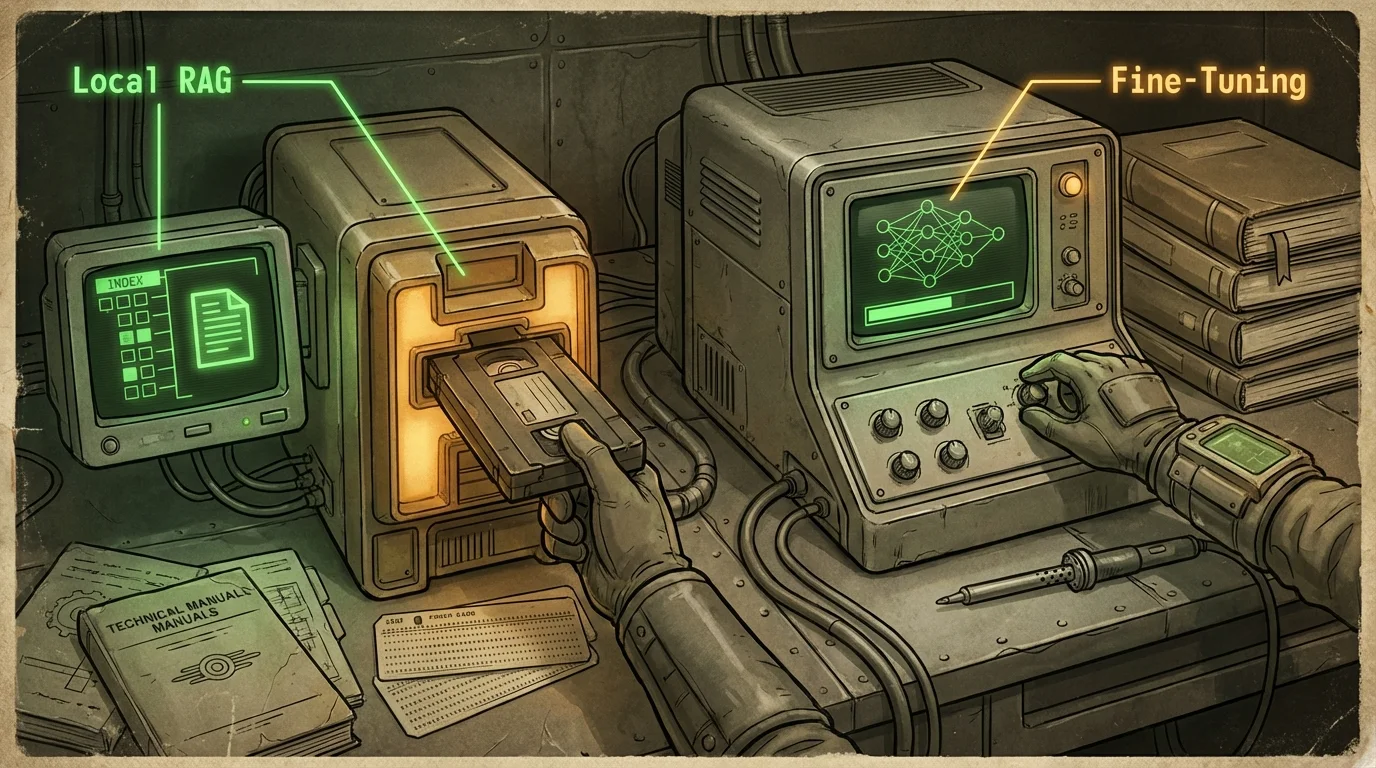
For an offline AI app, this matters a lot. You can add new documents without touching the model. You can cite sources because you know exactly which chunk the answer came from. And if something is wrong, you can fix the document rather than retrain anything.
The technical side: documents get split into chunks, embedded into vectors using an embedding model, and stored in a local vector database. When you ask a question, the query gets embedded too, and the system finds the chunks with the closest vectors. Those chunks get stuffed into the model's context window, and the model answers based on them.
That is local RAG in plain English. No cloud. No API call. No document leaving your machine.

What fine-tuning actually does
Fine-tuning means continuing the training process on a base model using your own data. The model sees your documents, medical notes, technical manuals, field guides, or whatever you feed it, and adjusts its weights to reflect that content.
The result is a model that has absorbed your material at a deeper level. It might answer faster on certain topics. It might adopt a specific tone or follow a particular response format consistently. It can learn patterns that are hard to inject through a system prompt alone.
Sounds compelling. The catches are real, though.
Fine-tuning requires a training pipeline. You need to format your data correctly, run the training job (which takes GPU time and expertise), evaluate the results, and repeat if they are bad. For a small dataset, results are often disappointing because models need enough examples to generalize. And crucially: once you fine-tune on data, the model does not cite that data. It absorbed it. It cannot tell you where it learned something. It just knows, or thinks it knows.
That last point is the killer for knowledge-retrieval use cases. If you need answers you can verify, fine-tuning is the wrong architecture.
Why local RAG vs fine-tuning usually resolves in favor of RAG for offline apps
Here is the practical comparison:
| Factor | Local RAG | Fine-tuning |
|---|---|---|
| Add new documents | Yes, anytime | Requires retraining |
| Source citations | Yes, inherently | No |
| Setup complexity | Moderate | High |
| GPU required for setup | Usually no | Yes, or cloud credits |
| Stays current | Yes | Baked in at training time |
| Works fully offline | Yes | Yes (after setup) |
| Verifiable answers | Yes | No |
| Storage overhead | Vault + small vector DB | New model weights |
For an offline knowledge app, the citation problem alone mostly decides this. If you cannot see where an answer came from, you have to trust the model completely. With a local vault and RAG, you can pull up the source document and check. That matters when you are using the system for anything consequential, whether that is medical reference, legal documents, field guides, or repair manuals.
The update problem matters too. Fine-tuned models are frozen at training time. Add 200 new documents to your vault? With RAG, you embed them and they are immediately searchable. With a fine-tuned model, you are planning a new training run.
Wisdoom uses local RAG with a built-in vault specifically because of these tradeoffs. The library is the product. The model reads from it. You can verify every answer.
When fine-tuning still makes sense
Fine-tuning is not useless. It solves specific problems well.
Format and behavior consistency. If you want a model to always respond in a particular structure, follow a strict template, or maintain a specific persona across every response, fine-tuning can bake that in more reliably than system prompts alone. Prompting is fragile. Fine-tuning is not.
Domain-specific language. If your field uses terminology that general models handle poorly, or you need the model to understand jargon, abbreviations, or notation in a specific way, fine-tuning on domain examples helps. Medical, legal, and engineering contexts sometimes benefit here.
Task specialization. If the model only needs to do one narrow thing extremely well, like classify support tickets or extract structured data from a fixed document format, fine-tuning a small model for that task can outperform a general model with RAG. Specialized beats general for specialized tasks.
Speed on known-fixed content. If your knowledge base genuinely never changes and you need very fast responses without retrieval latency, a fine-tuned model on that fixed corpus has no lookup step. For embedded or edge applications with tight latency requirements, that can matter.
But notice what these cases have in common: they are not general offline knowledge apps. They are narrow, specialized pipelines. If you are building a resilient offline AI setup for personal or household use, prepper preparedness, rural self-sufficiency, or privacy-first productivity, none of those cases apply. You want a broad library you can add to, answers you can verify, and a setup you can maintain without a machine learning background.
The hidden cost of fine-tuning people skip past
Consumer hardware can run inference on quantized models pretty comfortably now. A 7 billion parameter model on a laptop with 16 GB of RAM is realistic. Fine-tuning that same model is a different story.
Even parameter-efficient methods like LoRA require more VRAM than inference alone, careful data preparation, and enough examples to see results worth having. Low-quality training data produces a model that confidently says wrong things, which is worse than a model that says it does not know.
You also need evaluation. How do you know the fine-tuned model is better? You need a test set, baselines, and someone who can read the outputs critically. For a one-person homelab or a prepper setup, that is a significant overhead.
RAG has complexity too. Chunk size, embedding model quality, retrieval parameters, and document preprocessing all affect quality. But those are tuning knobs you can adjust without touching model weights. Swap out a document, change a chunk size, re-embed. Done in minutes, not days.
For context on how local model setup compares in practice, the Wisdoom blog has more on sizing, hardware tradeoffs, and what to expect from a real offline setup.
How retrieval quality determines everything in local RAG
The weak point of RAG is retrieval quality. If the wrong chunks get pulled, the model answers based on irrelevant context. Garbage in, garbage out, but localized to your vault.
This is worth taking seriously. Common failure modes:
- Chunks that are too large include irrelevant material that dilutes the relevant parts
- Chunks that are too small lose context and become meaningless out of sequence
- Poor embedding models fail to match semantically similar content correctly
- Documents with messy formatting get chunked at wrong boundaries
- Queries that are too vague retrieve poor matches
The fixes are not mysterious. Clean document preparation, sensible chunk sizes (200 to 500 tokens is a common starting range), a decent embedding model, and sometimes hybrid retrieval that combines vector search with keyword matching all help significantly. MTEB benchmarks are a useful reference for comparing embedding model quality if you want to dig into that.
The point is that local RAG quality is improvable by anyone who can edit documents and adjust a few settings. Fine-tuning quality requires ML expertise to improve. That asymmetry matters for real-world offline setups where the person maintaining the system might not be a machine learning engineer.
If you want more detail on building a library that retrieval can actually use well, the post on how to build an offline knowledge base goes deeper on document sourcing and preparation.
Combining both: when hybrid setups make sense
Some production systems use fine-tuning and RAG together. The model gets fine-tuned for format, tone, or domain behavior, and then RAG handles fact retrieval at query time. You get behavioral consistency from the fine-tune and verifiable, updatable knowledge from the vault.
This is technically sound. It is also more complex and heavier to maintain. For most people reading this article, it is overkill.
The case for hybrid makes more sense if:
- You have a specific response format the model must always follow
- Your domain language is unusual enough that the base model struggles with it
- You have the GPU resources and expertise to run training jobs
- You have already built a solid RAG pipeline and want to push further
If none of those are true, stay with RAG. Build a good vault. Improve your chunking. Add more sources. You will get 90% of the practical benefit at 20% of the complexity.
FAQ
Can I do local RAG without a GPU? Yes. Embedding and retrieval can run on CPU, though it is slower. Inference on the model side benefits from a GPU but many quantized models run acceptably on modern CPUs or Apple Silicon. The retrieval step itself is lightweight.
Does fine-tuning make a model smarter? Not in a general sense. It makes the model behave differently on the distribution of your training data. Outside that distribution, it can get worse. Fine-tuning specializes, it does not upgrade.
How much storage does a RAG vault need? The raw documents plus embeddings. Embeddings are typically a fraction of the original document size. A 1 GB document library might produce 50 to 150 MB of embeddings depending on the embedding model and chunk count. Very manageable.
What embedding model should I use for local RAG? nomic-embed-text and similar small open models run well locally and perform competitively. For a fully offline setup, choose a model you can download once and run without a network call.
Is fine-tuning permanent? The fine-tuned weights are a file. You can keep the original base model weights too. Nothing is destroyed. But reversing a bad fine-tune means going back to the base or running another training job, not just editing a document.
Can I use RAG on top of a fine-tuned model? Yes, and sometimes that is the right architecture. Fine-tune for behavior and domain language, retrieve for facts. Just be realistic about the maintenance overhead of managing both.
What to actually do
For an offline knowledge app, start with RAG. Build your vault. Get your retrieval working well. If you find specific, narrow behavioral problems that prompting cannot fix, then evaluate whether fine-tuning is worth the cost for that specific problem.
Most offline AI use cases, preparedness libraries, personal knowledge bases, offline reference tools, privacy-first document search, are retrieval problems, not training problems. The model does not need to memorize your documents. It needs to find them and read them accurately.
Wisdoom is built on this principle. Local vault, local model, citations on every answer. It runs offline on macOS, Windows, and Linux. If you want a working local RAG setup without building the pipeline yourself, that is what it does.